

Apostille and legalization: differences and when to use each
Hague Convention, Italian documents abroad and how to choose between apostille and consular legalization.
March 22, 2026 · 7 min
You have an Italian birth certificate to submit to an office in Argentina, or an Italian criminal record certificate (casellario giudiziale) for an employer in Australia? Before sending any paper, you need to know whether you need an apostille, consular legalisation, or both in sequence with sworn translation. Getting this step wrong means weeks of delays, refusals, and double costs.
This guide explains clearly what the 1961 Hague Convention provides, how it works in Italy, and which documents most often require it—without assuming you already know Italian bureaucracy.
What an apostille is
An apostille is not a translation and not a “visa” on the document. It is an international certificate attesting the authenticity of the signature, the authority that issued the act, and, where applicable, the seal or stamp on a public document. In practice it tells the destination country: “this act was issued by a recognised Italian office and the signature is genuine.”
Apostille applies only to public acts: registry certificates, civil status extracts, judgments, notarial deeds, criminal record certificates, prosecution office certificates, and similar. A private contract between two people is not a public act—but it may become one if authenticated by a notary.
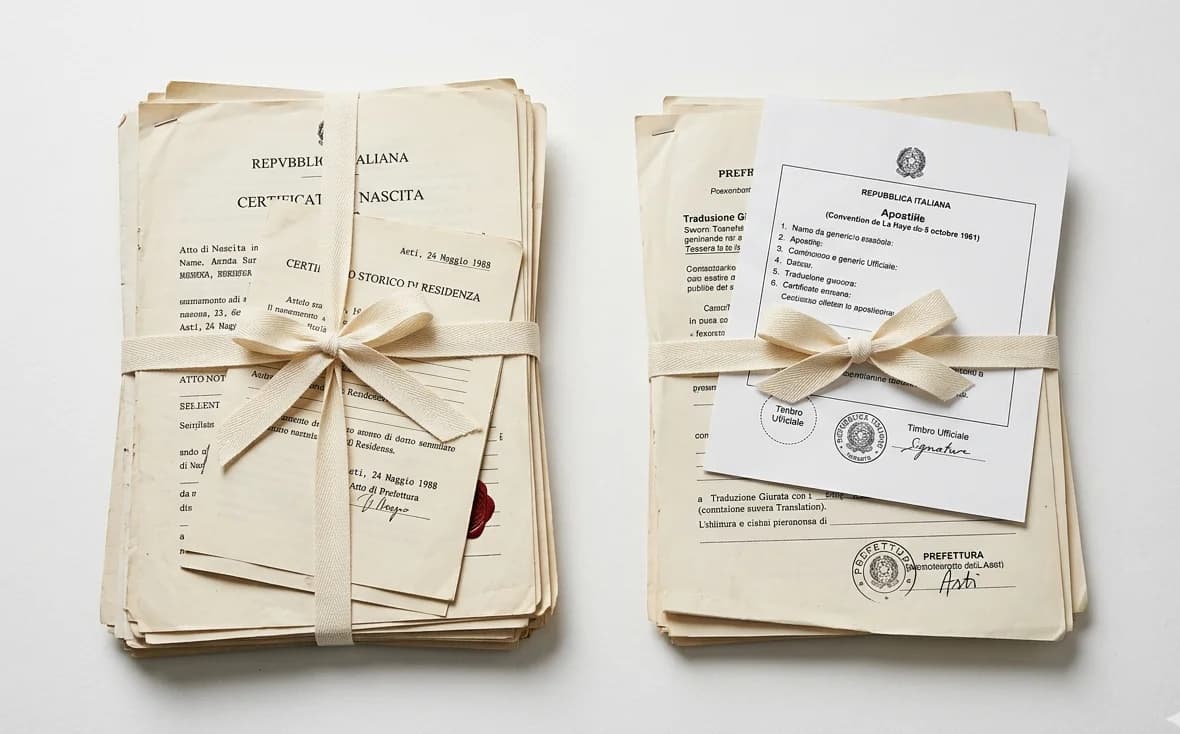

Apostille and legalisation: not the same thing
Many people confuse the two terms because both help a document be “recognised” abroad. The difference is substantial.
Apostille (Hague Convention)
- For countries party to the Hague Convention
- A single step in Italy: apostille at the competent authority — Prefettura or Procura, depending on the type of act
- No consular legalisation at the destination country’s consulate in Italy
- Standardised format, often as an attached sheet or annotation
Consular legalisation
- Required for countries not party to the Hague Convention
- Longer path: authentication in Italy + legalisation at the foreign country’s consulate
- Generally higher cost and longer timelines
- Some countries also require Foreign Ministry legalisation before the consulate
The 1961 Hague Convention
The Hague Convention of 5 October 1961 abolished, among member states, the requirement for diplomatic legalisation of foreign public acts. Italy was among the first signatories: for decades apostille has been routine for those using Italian documents abroad and, conversely, foreign documents in Italy.
Over a hundred countries are party today, including most of the EU, the United States, Canada, Australia, much of Latin America, and several Asian states. The list is updated: before starting a procedure, check the current status on the Convention website or confirm with the receiving body (university, consulate, employer).
Apostille does not certify the content of the document—it only certifies that the act is authentic and the Italian authority’s signature is genuine.
— Hague Convention (summary)
When you need apostille vs legalisation
The choice depends exclusively on the country where you will use the document—not your nationality or where you live.
- Apostille: destination country party to the Hague Convention (e.g. USA, Brazil, France, Germany, Spain, UK)
- Legalisation: non-party country (e.g. some Middle Eastern and African states—verify case by case)
- Translation only: rare for public acts destined abroad; almost always apostille or legalisation first, then sworn translation in the required language
- No formalities: only if the receiving body explicitly accepts plain copies or digital documents with cross-border validity (e.g. some EU certificates in standardised format)
Italian documents that most often need apostille
Not all documents follow the same process: the issuing office and the authority that affixes the apostille (Prefettura or Procura) depend on the type of document. Here are the most frequent cases we handle with clients.
- Registry and civil-status certificates (residence, family status; birth, marriage, death)—from the municipality or via ANPR
- Italian criminal record certificate—for work, visas, adoptions, immigration; see our guide on criminal record online
- Pending charges certificate—often requested together with the criminal record
- Notarial acts (power of attorney, authentications, sale deeds)
- Prosecution and court certificates—for legal procedures abroad
- School and university certificates—only when issued as public acts or with ministerial legalisation, depending on the country
For registry certificates destined for party countries, the typical flow is: request certificate → apostille at Prefettura → sworn translation into the destination language → delivery to the requesting body.
How to obtain apostille in Italy
The authority that affixes the apostille is not unique: it depends on the type and origin of the document, not on a single rule for every Italian act. Italy designated the competent authorities to the HCCH (Art. 6 of the Convention); Prefetture — territorial government offices restate that split.
Prefettura or Procura: which authority is competent
- Procura della Repubblica at the court in whose jurisdiction the act was formed: judicial documents and notarial acts. As a rule this includes the Italian criminal record certificate (Casellario giudiziale) and pending charges certificates issued by that Procura, copies of court acts, and deeds of the local notary.
- Prefettura (Ufficio territoriale del Governo) with territorial competence: the other administrative documents covered by the Convention, in particular documents from municipalities (registry and civil status) and other administrative acts. For Valle d’Aosta and the provinces of Trento and Bolzano, the authorities named in the designation apply.
It is not true that all apostilles are done at the Prefettura, nor that all are done at the Procura. Taking the act to the wrong office is a frequent mistake: the office checks signatures for which it holds a specimen, not “any” Italian document.
Italian criminal record certificates for use abroad
If an Italian criminal record certificate must be presented abroad, the receiving authority may require an apostille or legalisation, a translation, and freshness limits on the certificate. It is not true that the Casellario always needs an apostille, nor that it always needs a translation: that depends on the destination country, the recipient, and the purpose of the file. When an apostille is required, the competent authority for this judicial certificate is generally the Procura, not the Prefettura.
The recommended sequence is almost always: obtain the document → apostille (if required) → sworn translation (if required) → delivery abroad. Reversing steps—for example translating before apostilling—may force redoing the translation on a document already bearing apostille, at extra cost. The order to check — and what to ask the recipient about translating the file — is in Document, apostille and sworn translation: what is the correct order?.
Timescales are not fixed: they depend on the competent office, the type of document and the workload. The timescale is stated in the quote. Costs are generally modest compared with full consular legalisation, but must be added to certificate issuance time and sworn translation, if required.
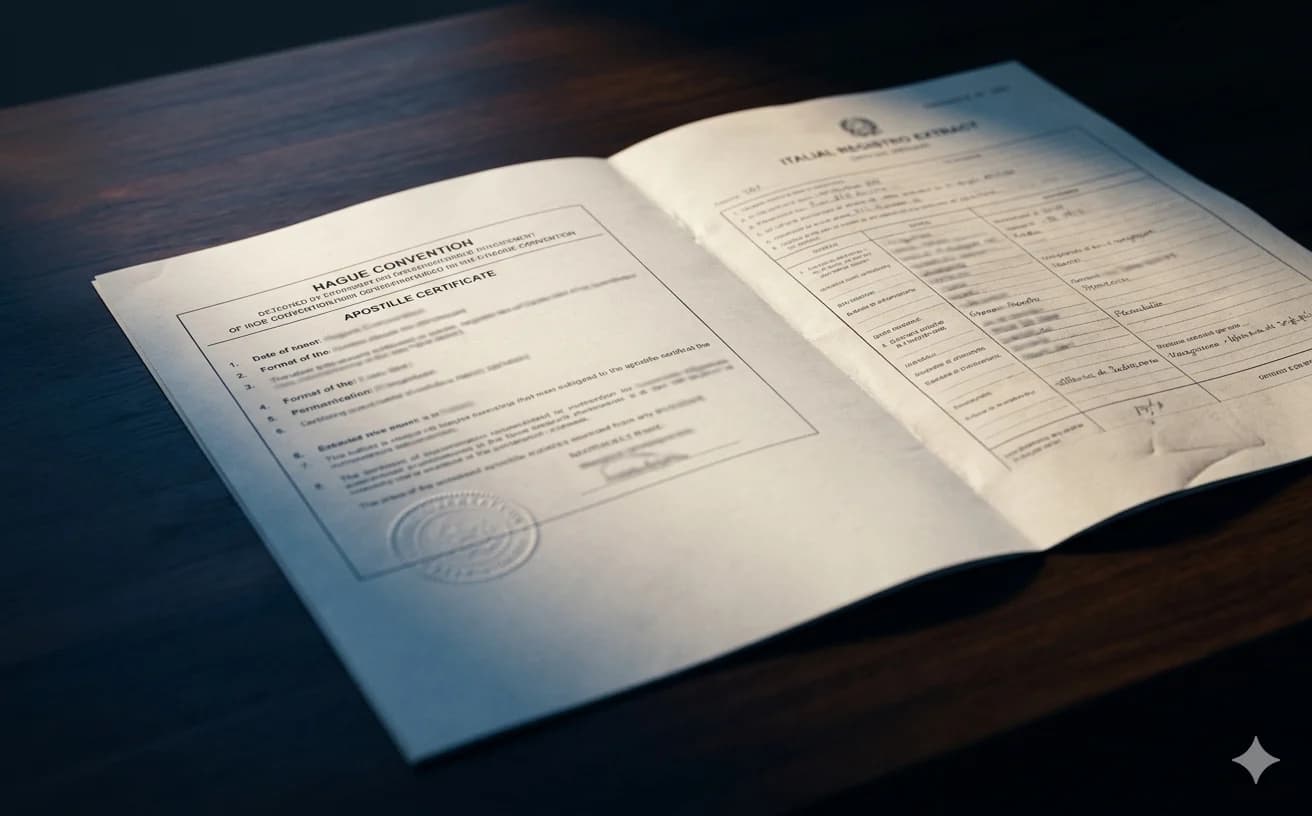
Mistakes to avoid
- Requesting apostille on an unauthenticated photocopy when original or certified copy is required
- Apostilling a document for a country not party to the Convention
- Taking a judicial act (e.g. criminal record certificate) to the Prefettura, or a municipal certificate to the Procura
- Presenting abroad an apostilled document without translation when the authority requires sworn translation
- Confusing apostille with consular authentication of content (which the Convention does not provide)
ItaloDocs is a private documentary support agency: apostilles are affixed by competent Italian public authorities, not issued by us as a public body; we do offer apostille and legalisation services, handling the process before the offices required by law. We can also coordinate certificate requests, verify which document you need, follow timelines and destination-country requirements, and organise sworn translation when needed. Certificates and apostilles always appear on documents issued or legalised by competent authorities under current regulations.
If you have an Italian document to use abroad and do not know where to start, describe the destination country and type of procedure: we help you build an orderly path without unnecessary steps. See our document legalisation and apostille service.