
Sworn translation: when you need it and how to request it
Universities, citizenship, employment, courts and licences: when sworn translation is required and which languages we handle.
April 10, 2026 · 6 min
You have a birth certificate in Spanish, an employment contract in English, or a university degree in Portuguese: for many Italian authorities a “faithful” translation by you or a general translator is not enough. You need a sworn translation—in Italy also called a traduzione asseverata—with an asseverazione that attests the correspondence between original and translation, according to the rules in force. Understanding when it may be requested and how it is obtained saves rejections, repeat shipments, and months of delay.
What sworn translation is
It is a translation whose correspondence with the original is asseverated before the court (or as provided). Italy does not have a compulsory national roll for asseverazione: what counts is that the translator is authorised to carry out the act under the rules in force. The resulting document can be presented to municipalities, universities, ministries, courts, and consulates as a sworn translation of the original; acceptance remains a matter for the receiving body.
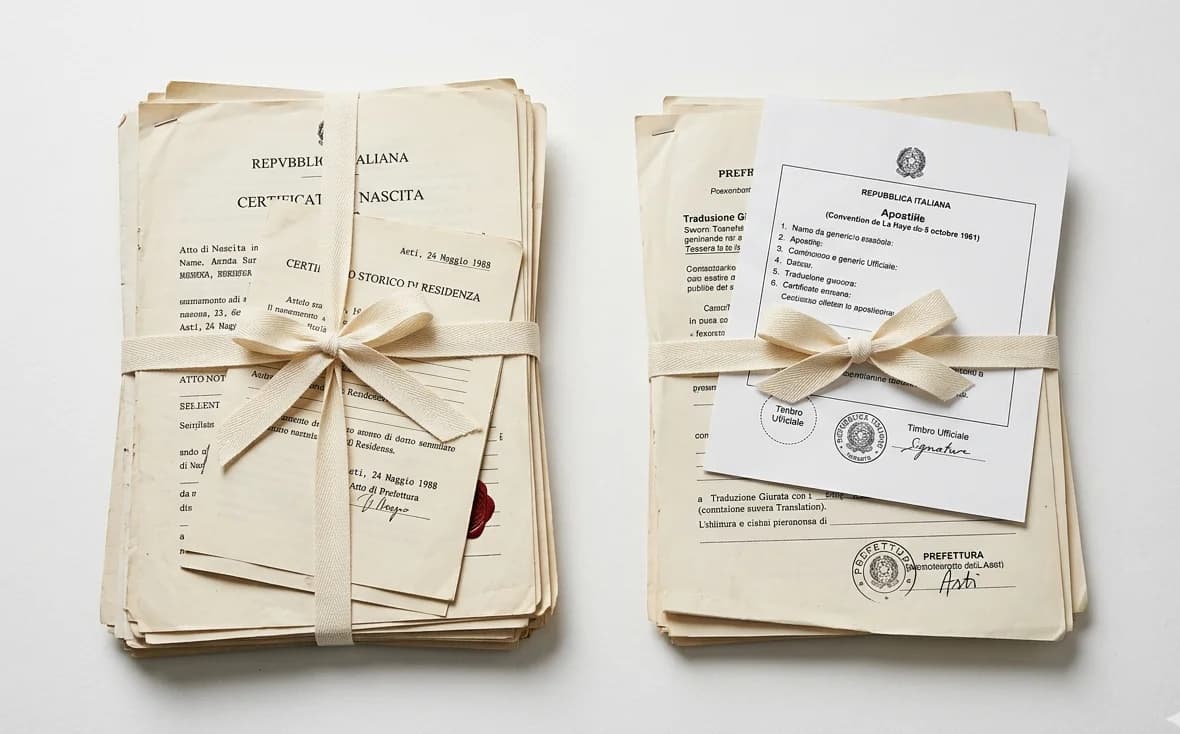
Do not confuse it with certified translation in other countries (wording used in other legal systems), a simple in-house company translation, or apostille: the latter certifies the authenticity of the signature on the original act, it does not translate content. ItaloDocs offers only sworn translation, not certified translation or plain translation as alternative services. You often need both: apostille on the foreign act and sworn translation into Italian.

When sworn translation is required
Each authority may have its own rules. A sworn translation may be requested when a foreign-language document must have formal effect in Italy, or when an Italian document must have formal effect abroad in official procedures. It is not automatic in every case: confirm it with the receiving body.
If you already have a birth certificate and need a sworn translation, see the dedicated page.
Citizenship and consular procedures
- Foreign birth, marriage, or death certificates for citizenship by descent
- Court judgments, criminal records, and acts for reunification or naturalisation
- Documents for transcription at the Italian municipality and coordination with AIRE
Universities and education
- Foreign degrees for master’s or PhD enrolment
- Training programmes, ECTS credits, transcripts for credit recognition
- Documentation for scholarships and international offices
Work and social security
- Contracts, offer letters, and foreign professional certifications
- Documents for qualification recognition or intra-EU transfer clauses
- Medical certificates or mandatory courses in non-Italian languages
Driving licence and motor vehicles
- Foreign licences for conversion or renewal in Italy
- Medical certificates and technical sheets when required by competent offices
- Documentation for foreign residents registering vehicles
Courts, notaries, and legal procedures
- Acts for civil, criminal, and administrative cases
- Powers of attorney, wills, estates with assets or heirs abroad
- Commercial contracts and company documentation for registrations
Languages: Italian, Spanish, English, and others
The most requested combinations to and from Italy are Italian ↔ Spanish and Italian ↔ English, for migration, study, and work with the Americas, UK, and English-speaking countries. ItaloDocs handles these pairs with a clear online process; for French, Portuguese, German, Romanian, and other languages we assess requests on a custom quote, depending on availability of qualified translators and court timing for the asseverazione.
Translation from Italian for use abroad
If an Italian act must be valid in a country that does not accept Italian, you may need sworn translation into the destination language plus apostille on the original. For registry certificates and civil status acts, verify the full chain: extract → apostille → translation → possible consular legalisation. The order to check (document → apostille or legalisation if needed → translation if needed) is in Document, apostille and sworn translation: what is the correct order?.
How to obtain it: practical steps
- Verify the original is complete, legible, and apostilled if required
- Choose a qualified translator for the language pair
- Have translation and certification carried out as provided by law
- Submit original + translation to the requesting authority
- Keep digital copies and track any validity deadlines
With ItaloDocs you upload the document, indicate the receiving authority (municipality, university, court, consulate), and receive a transparent quote. After online confirmation you track the case until delivery of files ready for use.

Mistakes that get applications rejected
- Non-sworn translation presented as sworn
- Translation in a language other than the one required
- Incomplete original (missing page, stamp, or apostille)
- Different name or birth date between original and translation
- Expired document or old registry certificate paired with a new translation without consistency
Correct sworn translation does not add words: it makes them legally recognisable.
Timelines, costs, and urgency
Timelines depend on document length, language, court workload for certification, and correctness of the incoming file. A clear quote before starting avoids surprises. Real urgency exists (visa deadlines, competitions), but scan quality and metadata matter as much as promised “speed” on social media.
Sworn translation and relocation
Those following the guide on moving to Italy often face a mixed package: criminal records, qualifications, civil status extracts. Aligning translations and apostilles before the visa or residence permit application reduces the risk of repeating the whole process.
Difference from other roles: interpreter, notary, agency
An interpreter assists orally in hearings or meetings; they do not replace sworn written translation. A notary authenticates acts but does not automatically translate foreign documents. Documentary support agencies like ItaloDocs coordinate translation, apostille, and shipping without replacing public offices that decide on acceptance.
Checklist before sending files
- Receiving authority identified by exact name
- Language pair confirmed
- Complete original and apostille if necessary
- Names and dates consistent across the file
- Required delivery format (PDF, paper, PEC)
Conclusion
Sworn translation is the legal linguistic bridge between your document and Italy (or vice versa). Whether you need university enrolment, licence conversion, or a citizenship file, investing in the right translation the first time costs less than restarting the whole procedure.
Upload your document and request a sworn-translation quote: Italian, Spanish, English, and other combinations on request, with the professional tone serious procedures deserve.
The document speaks one language; sworn translation gives it an official voice in another.